
NEWS
JUST IN: Chinese factory in Guangdong is assembling a humanoid robot every 30 minutes while Tesla, Figure, and Boston Dynamics still struggle to deliver 10 thousand per year

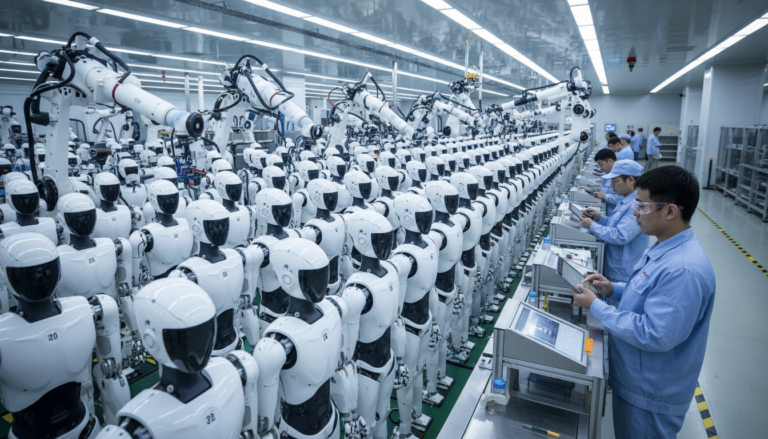
China’s Robot Revolution Accelerates as Guangdong Factory Builds Humanoids Every 30 Minutes
A massive humanoid robot factory in China’s Guangdong province is sending shockwaves through the global tech industry after reports revealed it can assemble one humanoid robot every 30 minutes — a production pace that many Western robotics giants have yet to match. While companies like Tesla, Boston Dynamics, and Figure AI continue refining prototypes and limited production lines, China appears to be entering the age of industrial-scale humanoid manufacturing.
The new automated production facility, located in Foshan, Guangdong, reportedly has the capacity to produce up to 10,000 humanoid robots annually. According to multiple reports, the factory integrates 24 precision assembly stages and 77 inspection checkpoints, dramatically increasing efficiency compared to traditional manufacturing methods.
The development marks a major turning point in the global robotics race. For years, humanoid robots were viewed as futuristic experiments — impressive demonstrations that struggled to move beyond viral videos and research labs. But China is now attempting to scale humanoid production the same way it once scaled electric vehicles, solar panels, and smartphones.
Analysts say the secret behind China’s rapid progress is its powerful manufacturing ecosystem. Guangdong already dominates industrial robot production in China, accounting for nearly half of the country’s robotics output. The humanoid factory benefits from deep supply chains, lower production costs, state-backed industrial policies, and advanced automation infrastructure.
The contrast with Western competitors is becoming increasingly noticeable. Boston Dynamics remains famous for its highly advanced Atlas robot, capable of backflips and parkour-style movement, but large-scale commercialization has remained limited. Meanwhile, Tesla continues developing its Optimus humanoid robot, promising future deployment in factories and homes, yet mass production targets have repeatedly faced delays. Startups like Figure AI are also racing to scale manufacturing but are still far from China’s reported industrial output.
Chinese robotics firms such as UBtech Robotics, Unitree Robotics, and AgiBot are rapidly expanding, introducing lower-cost humanoid models while increasing production capacity. Some humanoid robots developed in China are now reportedly priced below $20,000, significantly undercutting many Western rivals.
Experts believe this could reshape global manufacturing over the next decade. China’s aging population and shrinking workforce have pushed Beijing to aggressively invest in automation and AI-driven robotics. Humanoid robots are increasingly viewed not just as futuristic gadgets, but as potential replacements for factory workers, warehouse staff, and even service employees.
The implications extend far beyond economics. If China successfully dominates humanoid robot production the way it dominates battery manufacturing and consumer electronics, it could gain a major technological advantage in the next industrial era. Some analysts are already calling humanoid robotics “the new electric vehicle race” — and China appears determined to lead it.
For now, the world’s biggest robotics companies are watching closely as Guangdong’s factory transforms humanoid robots from science fiction into mass-produced reality.

WŁAŚNIE OGŁOSILI! Zobacz więcej

Totalny wstrząs w sondażach! 🤯 Takich wyników jeszcze nie było. Zobacz 👇

Uuu…. Co się dzieje! 😱 @obserwujący⤵️⤵️

🚨 HE’S COMING HOME: The same former first-round draft pick who once electrified Rogers Place is eyeing a sensational return to the Edmonton Oilers — and the entire NHL world is already trembling! 🏒🔥 Full story via 👇

Ugandan-Born NYC Mayor Sues to Stop Trump From Blocking Welfare-Dependent Green Cards

Late-night host Jimmy Kimmel recently sparked a debate online after suggesting the Trump era will ultimately be remembered as one of the most shameful chapters in American history.

Trump says Zelenskyy must stop striking Russian diesel infrastructure because the attacks are contributing to fuel shortages.

Waldemar Żurek od ponad roku kieruje Ministerstwem Sprawiedliwości i pozostaje jedną z najbardziej wyrazistych postaci rządu.

Pierwsze 72 godziny są kluczowe ‼ Służby wyjaśniają, co należy zrobić ⬇

Czegoś podobnego nikt się nie spodziewał 😱😱👇

Wystarczył jeden oficjalny komunikat, by na Wyspach zapanowała przejmująca cisza… 💔🕯️
